
Available on iOS & Android
Read BTC Anywhere
Carry the full magazine experience in your pocket — stories, podcasts, exclusive perks, and more. Download the free app today.
Carry the full magazine experience in your pocket — stories, podcasts, exclusive perks, and more. Download the free app today.
You probably know the 1200-calorie diet by now. It’s that persistent dieting relic that gets passed between fitness forums and “wellness” apps like a cursed heirloom. It’s the nutritional equivalent of a toddler’s snack plan and yet somehow adults still treat it like scripture.
Why does this number keep hanging around, whispering its toxic promise that less equals discipline and more equals failure? It’s not science. It’s obedience training.
Calorie restriction shouldn’t be a badge of honor. It should be a cultural embarrassment we retire for good.
Before we get into physiology, it’s worth straightening out where this idea came from. The 1200-calorie rule didn’t spread because it was thoughtful or individualized. It spread because it felt like a shortcut.
It’s a low number that’s easy to remember, easy to prescribe, and easy to enforce. Coaches and influencers favor simplicity, and “1200” is simple. It promises quick results, and in the short term it delivers them. Any meaningful calorie deficit will produce weight loss initially. That early drop creates the illusion that the approach is sound, even as the long-term consequences go unexamined.
What rarely gets asked is what happens next. What it does to energy, hormones, focus, and drive. What it costs in terms of sustainability and quality of life. The conversation usually stops at the scale, because that’s the cleanest metric to point to, even if it’s the least informative.
This myth persists because it quietly reframes obedience and extreme restriction as success. If you can stick to it, you’re disciplined. If you can’t, the failure is personal.
You can white-knuckle a 1200-calorie diet for a while. You can log every bite, ignore hunger cues, and tell yourself that fatigue is just weakness leaving the body. None of that changes the fact that the human body is wired for survival over aesthetic compliance.
When calories drop too low for too long, the body adapts and metabolism slows. Not because it’s “broken,” but because it’s efficient. Energy expenditure quietly drops as the body learns it can’t trust consistent fuel to be available. Hunger hormones crank the volume up, making food thoughts louder and harder to ignore. Sleep suffers. Recovery suffers. Focus slips. What people call a “lack of discipline” is often just physiology doing exactly what it’s supposed to do.
This is why extreme restriction feels manageable at first and miserable later. Early weight loss creates the illusion that the system is working, while the body is already recalibrating behind the scenes. The longer deprivation continues, the harder the body pushes back out of self-preservation.
Which is why framing failure as a personal flaw is so effective and so cruel. It shifts blame away from a broken premise and onto the person trapped inside it. But the reality is that the body resists punishment. It responds to fuel.
Now let’s pull this out of the lab and into everyday life, because the consequences of chronic under-eating don’t stop at metabolism.
When people consistently eat less than their bodies need, food stops being food. It becomes a source of tension, negotiation, and self-surveillance. Meals turn into math problems. Hunger becomes something to override. Satisfaction starts to feel suspicious. Over time, this reshapes not just eating habits, but mood, focus, and self-perception.
Irritability gets written off as stress. Brain fog gets blamed on busyness. Low energy becomes a personality trait. The common thread rarely gets named: people are trying to function, work, parent, train, and think clearly while under-fueling their bodies. And then they’re told the problem is discipline.
Extreme restriction doesn’t just change how you eat. It changes how you move through the world. It narrows attention. It shrinks risk tolerance. It keeps people preoccupied with doing things “right” instead of doing things well. When energy is scarce, ambition gets quieter, confidence gets thinner, and life starts to revolve around control instead of capacity.
What makes this especially insidious is how normal it’s become. The idea that eating less is the default “health move” gets reinforced everywhere: apps that auto-suggest dangerously low targets, programs that praise restraint without context, conversations where hunger is treated like a moral failure instead of a biological signal. The message is subtle but consistent: if something feels off, your body is the issue. Not the framework asking it to run on empty.
This belief system doesn’t just promote thinness. It promotes compliance and teaches people to distrust their internal signals and outsource authority to numbers, plans, and rules that ignore their actual lives. Undereating works so well as a cultural norm because it doesn’t look extreme. It looks responsible. It looks controlled. It looks like self-improvement. But over time, it disconnects people from their needs and convinces them that exhaustion is the price of doing things “right.”
That’s not “health”. That’s a system that rewards deprivation and calls it virtue.
This isn’t about eating the biggest burger you can find. It’s not about swinging to the opposite extreme or turning nutrition into another identity to signal. It’s quieter than that, and far more disruptive.
It looks like eating enough to train hard, recover well, and think clearly. Not just on good days, not just when it’s convenient, but consistently enough that your body stops bracing for scarcity. It looks like recognizing appetite as a signal of a functioning system.
Working with your body means paying attention to energy, performance, mood, and recovery instead of obsessing over whether you stayed under an arbitrary number that was never designed for your size, your activity level, or your life. It means letting go of one-size-fits-all prescriptions that flatten people into averages and pretending that complexity is the problem. Choosing to eat in a way that supports strength, clarity, and longevity requires more self-trust than following rigid rules. It asks people to stop outsourcing authority to apps, templates, and inherited diet math, and to start paying attention to how their bodies actually respond when they’re adequately fueled.
We’ve spent decades confusing restraint with virtue and discomfort with progress. But surviving on as little as possible and thriving in a well-fed body are not the same thing. One keeps people compliant and exhausted. The other creates capacity.
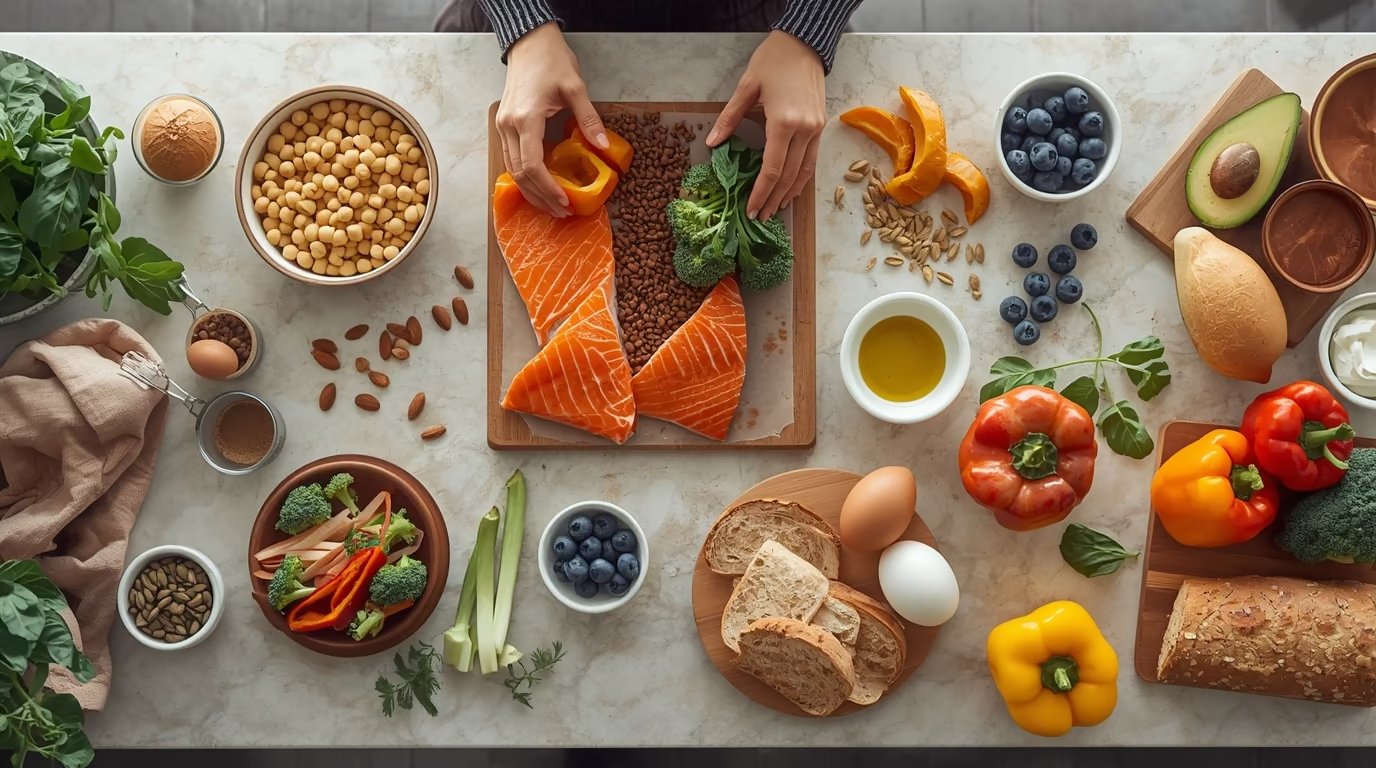
Eating enough shouldn’t feel radical. It’s simply the baseline for a body that’s meant to do more than get smaller. The 1200-calorie rule is a relic of a diet culture obsessed with control. In 2026, it’s time to retire that relic and unfuck your diet for good.
Members only from here
You've reached the preview. Subscribe for the full article — plus every issue and subscriber perks.
7-day free trial, then from $3.99/mo. Cancel anytime.
Instant access · Cancel anytime
“I started reading for the fashion pieces, but the essays are what kept me coming back.”
Maya R. · Toronto reader
The 1200-calorie figure spread not because it was scientifically sound but because it was simple to prescribe and produced quick initial results. It is functionally a toddler's snack plan for an adult body, and the long-term consequences on hormones, metabolism, and mental health go largely unexamined because the conversation usually stops at the scale.
The body's response to significant calorie restriction is to adapt by lowering metabolic rate, increasing hunger hormones, and reducing energy expenditure. Any meaningful deficit produces initial weight loss but the long-term result is a system calibrated to survive on less, making future weight maintenance harder and rebound more likely. The biology doesn't care about willpower.
It persists because it reframes obedience and extreme restriction as discipline. If you can stick to it, the culture calls you successful. If you can't, the failure is personal. The actual problem, that the number is arbitrary and the approach is unsustainable for most bodies, is buried under the narrative that anyone who struggles simply lacks commitment.
Keep exploring
Read the full story
7-day free trial · From $3.99/mo
Discover every article featured in our latest BTC issues, bringing the month's stories together in one place, so you can easily read and explore everything.
Read Now →Skin has no pronouns, and neither does great skincare. Discover clean beauty made for every skin type, age, and identity. Honest formulas, clear ingredients, and inclusive beauty that actually belongs to you.
Clean beauty for skin, not labels. Face mists, serums, moisturizers, and masks made for you, whoever you are.
Colour makeup and body care that work with your skin, not against it. Inclusive beauty, made honestly.
Beauty gifts and skincare gifts, curated into sets your favourite person will actually use and love.
You deserve stories that actually get you. A BTC magazine subscription unlocks unlimited access to in-depth, unfiltered articles, exclusive podcasts, and member perks you'll genuinely love. Try it free for seven days, then keep enjoying full access from just $3.99 a month. Cancel anytime, no pressure at all. Ready to go deeper?
7-day free trial, then from $3.99/mo. Cancel anytime.


.webp)
Comments
No comments yet
No comments to show yet. Subscribe to join the conversation.
Log in or subscribe to comment on this article.