
Available on iOS & Android
Read BTC Anywhere
Carry the full magazine experience in your pocket — stories, podcasts, exclusive perks, and more. Download the free app today.
Carry the full magazine experience in your pocket — stories, podcasts, exclusive perks, and more. Download the free app today.
At 1:38 PM on February 6, 2026, CCTV captured the exact moment a suicide bomber detonated explosives at the Khadija Tul Kubra Mosque in Islamabad. Security guards had stopped him at the entrance. He opened fire. Then he walked into a hall packed with Shia worshippers mid-Friday prayer and blew himself up.
Thirty-two people died. One hundred and seventy were injured. Glass and debris scattered across bloodied floors. Victims visible in the mosque's garden. Families running. Ambulances screaming toward hospitals already placing surgical teams on standby.
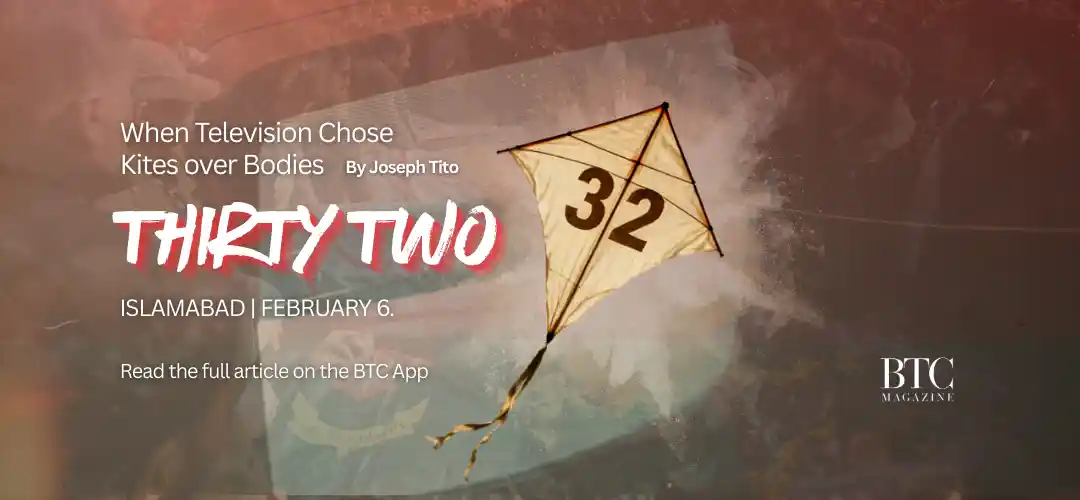
And on Pakistani television? Kites.
For hours after the bombing, the deadliest attack in Islamabad in seventeen years, major TV channels continued airing Basant festival programming. Celebrity interviews about kite-flying. Entertainment segments. Cheerful coverage of Lahore's spring celebration. Geo TV had actor Naeema Butt discussing Basant just as news of the blast broke.
The contrast wasn't subtle. It raised a question that applies far beyond Pakistan: What does it mean when a country's major news channels continue entertainment programming while the capital buries its dead?
I have a team in Islamabad. They texted me within minutes of the blast. My first instinct was to turn on the television, the way you do when something catastrophic happens, when you need to see it to believe it.
Basant coverage was still running.
I've seen this before. I lived in Bahrain during their internal conflict. I know what it looks like when certain communities' deaths become routine enough that regular programming continues. I know the math that gets done, consciously or not, when news organizations decide which bodies merit interrupting the schedule.
My best friend is Shia. So I know what it costs to be the community that gets calculated away.
This isn't theoretical for me. This is what I watched happen, again, on February 6.
The Metrics That Should Have Mattered
By every traditional news standard, the Islamabad bombing should have dominated coverage:
Deadliest attack in the capital since the 2008 Marriott Hotel bombing
Second major attack in three months (November courthouse bombing killed twelve)
Happened during Friday prayers, maximum casualties, maximum horror
CCTV footage of the exact explosion moment
ISIS claimed responsibility within hours
International condemnation from the UN, EU, US
A cousin of Islamabad's own Inspector General among the dead
Pakistani print media covered it extensively. Dawn ran comprehensive reporting. Express Tribune documented the aftermath. International outlets from Al Jazeera to CNN to the Washington Post covered it immediately.
But in Pakistan, television is how most people consume news. And for hours, television showed kites.
Were editors waiting for verified information? Avoiding broadcasting graphic scenes? Operating under regulatory constraints? Worried about inflaming sectarian tensions?
Perhaps. But Journalism Pakistan, a media watchdog, noted that "critics linked extended entertainment coverage to commercial interests and advertising." The Islamabad Bar Association called for a day of mourning.
Whatever the internal reasoning, the result was the same: viewers who turned on their TVs while the injured were still being pulled from the mosque saw spring festival coverage instead of the deadliest attack their capital had seen in nearly two decades.
The Pattern That Precedes the Silence
Pakistan's Shia community represents about twenty percent of the population, roughly fifty million people. They've been systematically targeted for decades. ISIS explicitly stated after this attack that it views Pakistani Shias as "legitimate targets." This bombing wasn't anomalous: the 2017 shrine attack killed ninety-plus, regular attacks plague Kurram district, sectarian violence that analysts warned would "inflame tensions" continues.
There's a calculation that happens, conscious or not, when news organizations decide what merits urgent coverage. Commercial considerations. Political pressure. Audience fatigue with certain types of violence. The normalization that happens when specific communities are targeted so regularly that each new massacre becomes, somehow, less newsworthy than the last.
You can call this systemic bias. You can call it market forces. You can call it editorial caution. But you can't call it coverage.
The Narrative That Moved Faster
Within hours, Defence Minister Khawaja Asif blamed Afghanistan and India for the attack, claims made without immediate evidence, rejected by both countries. Interior Minister Mohsin Naqvi announced four arrests including an "Afghan ISIS mastermind." The narrative took shape quickly: foreign enemies, cross-border terrorism, external threats.
What got less attention: This was the second major Islamabad attack in three months. The bomber operated freely in a heavily guarded capital. When asked about security lapses, Naqvi responded that "if one blast happens, 99 others are being foiled."
Al Jazeera's correspondent in Islamabad interviewed people after the bombing. "They say this is a lapse of security," he reported, "that authorities knew very well there was an imminent threat, given the fact that intelligence-based operations are going on in Balochistan and in Khyber Pakhtunkhwa province."
Whether through coordination or coincidence, the extended entertainment coverage meant fewer hours of uncomfortable questions about how thirty-two people died in Friday prayers while intelligence agencies were supposedly conducting operations against known threats.
It's easier to watch kites.
The Mechanics of Disappearance
This is how marginalized communities disappear in real-time. Not through dramatic censorship or obvious propaganda, but through the accumulated weight of editorial decisions that, individually, might seem defensible. Waiting for confirmation. Avoiding graphic content. Balancing competing priorities. Considering audience appetite.
But when those decisions consistently result in certain communities' deaths receiving delayed or diminished coverage, the pattern reveals something darker than any single choice.
The victims' families buried their dead on Saturday. Thousands gathered for funeral prayers. Coffins lined up. Mourners screaming. All of it well-documented by photographers whose images ran in international media.
But for hours on February 6, while bodies were still being identified, Pakistani viewers who turned on their TVs saw entertainment programming.
You could argue this was editorial judgment. Caution. Market-driven programming decisions. Fear of inflaming tensions.
You could also ask: How many times does this have to happen before the pattern becomes the point?
What Gets Counted
There's a reason print media covered this and television delayed. Print doesn't rely as heavily on advertising from festivals and consumer brands. Print doesn't face the same regulatory pressures. Print can afford to publish uncomfortable truths and wait for subscribers to find them.
But television's reach dwarfs print's. Television shapes what most people understand as urgent, important, newsworthy. And on February 6, television made a choice about what mattered most.
This matters beyond Pakistan. Every marginalized community worldwide knows this calculation. Knows their grief only becomes news when it's profitable or politically convenient. Knows that some deaths will lead broadcasts while others won't interrupt regularly scheduled programming.
The mechanics aren't subtle. They're mathematical. The question is whether we're willing to name what the math reveals about whose humanity gets counted and whose gets calculated away.
The Names You Don't Know
Thirty-two people died on February 6. Their names were printed in Dawn, Express Tribune, international outlets. Their families held funerals while TV aired festival coverage.
Analysts warned after the bombing that it could be part of a broader attempt to inflame sectarian tensions. They urged the government to take action against urban militant networks. They noted the danger of normalization.
But something was already normalized: that certain deaths aren't urgent news. That commercial and political pressures can delay coverage of mass casualties. That you can have bodies in a mosque and kites on screen, and the kites win.
This isn't speculation. It's what happened. The interpretation is yours.
But if this pattern continues, if the next attack on a marginalized community receives the same delayed coverage while entertainment programming runs, we'll know it wasn't an aberration.
It was a choice.
And systems don't build themselves, but they do sustain themselves.
Joseph Tito is the Editor-in-Chief of Between the Covers. He operates businesses in both Canada and Pakistan and has teams in Lahore and Islamabad.
Members only from here
You've reached the preview. Subscribe for the full article — plus every issue and subscriber perks.
7-day free trial, then from $3.99/mo. Cancel anytime.
Instant access · Cancel anytime
“I started reading for the fashion pieces, but the essays are what kept me coming back.”
Maya R. · Toronto reader
A suicide bomber detonated explosives at the mosque during Friday prayers after opening fire on security guards at the entrance. Thirty-two people died and one hundred and seventy were injured in what was described as the deadliest attack in Islamabad in seventeen years. CCTV captured the moment of detonation at 1:38 p.m.
Major TV channels including Geo TV continued airing Basant kite-festival programming for hours after the bombing, including celebrity interviews about kite-flying and entertainment segments covering Lahore's spring celebration. The contrast between ongoing festival coverage and the deadliest attack in seventeen years became the article's central provocation.
The article draws on the writer's experience in Bahrain during civil conflict, where he recognized the math that gets done when news organizations decide which bodies merit pausing for. The implicit calculation visible in Pakistani TV's coverage that day was that Shia worshippers' deaths were not newsworthy enough to interrupt Basant programming. His best friend is Shia. He names what that costs.
Keep exploring
Read the full story
7-day free trial · From $3.99/mo
Discover every article featured in our latest BTC issues, bringing the month's stories together in one place, so you can easily read and explore everything.
Read Now →Skin has no pronouns, and neither does great skincare. Discover clean beauty made for every skin type, age, and identity. Honest formulas, clear ingredients, and inclusive beauty that actually belongs to you.
Clean beauty for skin, not labels. Face mists, serums, moisturizers, and masks made for you, whoever you are.
Colour makeup and body care that work with your skin, not against it. Inclusive beauty, made honestly.
Beauty gifts and skincare gifts, curated into sets your favourite person will actually use and love.
You deserve stories that actually get you. A BTC magazine subscription unlocks unlimited access to in-depth, unfiltered articles, exclusive podcasts, and member perks you'll genuinely love. Try it free for seven days, then keep enjoying full access from just $3.99 a month. Cancel anytime, no pressure at all. Ready to go deeper?
7-day free trial, then from $3.99/mo. Cancel anytime.
.webp)
.webp)
Comments
No comments yet
No comments to show yet. Subscribe to join the conversation.
Log in or subscribe to comment on this article.