
Available on iOS & Android
Read BTC Anywhere
Carry the full magazine experience in your pocket — stories, podcasts, exclusive perks, and more. Download the free app today.
Carry the full magazine experience in your pocket — stories, podcasts, exclusive perks, and more. Download the free app today.
There are 8,000 books wrapped in Indigenous fabric scattered across Canada right now. Each bears a name in gold on its spine, lives cut short, stories unfinished, families forever altered. This is The Canadian Library: not your typical collection of dusty volumes, but a living memorial refusing to let Canada look away from its most devastating truths.
The numbers are staggering. Indigenous women comprise 16% of all female homicide victims and 11% of missing women, yet Indigenous people represent only 4.3% of Canada’s population. These women, girls, and Two Spirit people are more than statistics. TCL ensures they are remembered as daughters, mothers, sisters, and friends, whole human beings whose absence leaves gaping wounds.
When Grief Becomes Art
TCL is a nationwide art installation memorial for MMIWG and children, created to spark conversation and deepen awareness about Canada’s true history. Toronto-based activist Shanta Sundarason founded the project after moving to Canada and learning the brutal truths many citizens have long ignored. “At the end of the day, this is Canada's story,” she says. “Canadians need to take ownership.”
Inspired by British-Nigerian artist Yinka Shonibare’s The British Library, TCL wraps books in Indigenous-designed fabrics and embosses each spine with a name. It builds on the legacy of Métis artist Jaime Black’s REDress Project, which hangs empty red dresses to honor the missing and murdered. Where red dresses mark absence, TCL fills those voids, with names, fabric, memory.
The Power of Stopping in Your Tracks
TCL’s strength lies in its arresting presence. “You can't walk past one of these shelves without stopping,” says Sundarason. Each ‘micro gallery’, in businesses, schools, and libraries, uses IKEA Billy bookcases and books wrapped in Indigenous-sourced fabrics. When someone pauses, they can scan a QR code that leads to TCL’s site, where they’ll read family-written stories behind each name. “She is not just a number or a name,” says Dr. Linda Manyguns of Mount Royal University. “Her family tells you her story.”
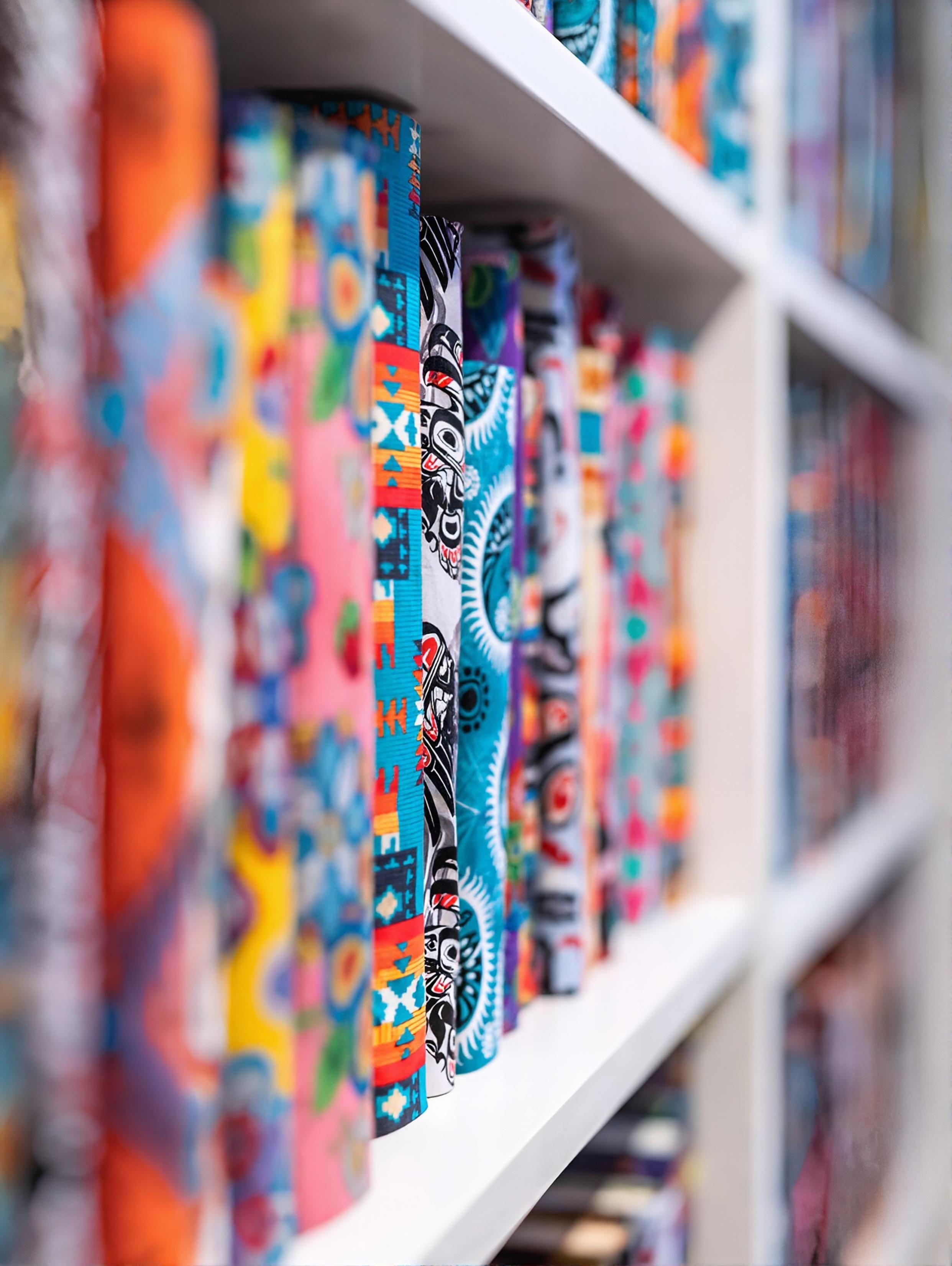
The project has found unexpected allies in mainstream spaces. IKEA became the first major retail partner, installing displays in all their Canadian stores. "It intends to educate, create awareness, advocate and start important conversations to help towards healing and true reconciliation," the retailer says. When a Swedish furniture giant is willing to use its retail space to confront Canadian colonial violence, something is shifting in the national conversation.
Some of the books remain nameless, representing those who may never be found, whose stories may never be told. Others carry names like Debbie Ann Sloss-Clarke, whose sister Mary Lou Smoke has been waiting more than two decades for justice. "The missing and murdered Indigenous women are sisters, mothers, aunties, grandmothers and the best friends of many," said Smoke. "It's important to always remember them, their lives were taken away before they had a chance to share their special gifts in this beautiful life."
TCL's ultimate vision is to bring all 8,000 books together in one massive permanent installation in a major museum or gallery, creating a national memorial that will serve as both education and remembrance for years to come.
We're living in a moment when Canada is finally being forced to reckon with its colonial past. The discoveries of unmarked graves at former residential school sites have shattered any remaining illusions about this country's "nice guy" reputation. "I think that the whole of Canada was traumatized with the discovery of children's bodies and I think that was a waking-up point. People want the truth," says manyguns.
The Canadian Library doesn't offer easy answers or comfortable solutions. Instead, it offers something more valuable: witness. In a culture that prefers to move on quickly from uncomfortable truths, these books insist on staying put. They demand that we see, that we remember, that we sit with the weight of what we've allowed to happen.
"Reconciliation will only happen when the majority of Canadians are truly educated. It's not going to be a political thing. It will be through conversations and education and that's what we are hoping to create," Sundarason says.
Art has always been about making the invisible visible, giving form to feelings that resist easy categorization. The Canadian Library does that in the most necessary way, by refusing to let murdered and missing Indigenous women and girls disappear twice. Once in life, and again in memory.
Because every name on every spine represents someone who deserved to live, to love, to contribute their gifts to the world. The least we can do is remember their names.
How You Can Be Part of This
The Canadian Library relies on community involvement to grow its impact. You can build a micro gallery in your business, organization, or local space, all you need is an IKEA Billy bookcase and some donated hardcover books. TCL provides the Indigenous fabrics and coordinates the names. You can also volunteer to help wrap books, sew fabric covers, or spread awareness on social media. Financial donations support local organizations creating their own micro galleries, and you can purchase fabrics from Indigenous-owned businesses or TCL bookmarks and scrunchies. Visit www.thecanadianlibrary.ca to learn how to get involved, because reconciliation isn't a spectator sport, and every Canadian has a role to play in ensuring these stories are never forgotten.
Members only from here
You've reached the preview. Subscribe for the full article — plus every issue and subscriber perks.
7-day free trial, then from $3.99/mo. Cancel anytime.
Instant access · Cancel anytime
“I started reading for the fashion pieces, but the essays are what kept me coming back.”
Maya R. · Toronto reader
The Canadian Library is a nationwide art installation memorial for Missing and Murdered Indigenous Women, Girls, and Two Spirit people. Created by Toronto-based activist Shanta Sundarason, it consists of 8,000 books wrapped in Indigenous fabric with each spine embossed in gold with a name. It is designed to make Canada confront what it has long been permitted to ignore.
TCL's power lies in its arresting presence in ordinary spaces. When a shelf of named books appears in a school or business, passersby cannot walk past without stopping. The micro gallery format places grief in the middle of daily life rather than in memorial spaces people can choose not to visit, making avoidance much harder.
Shanta Sundarason founded TCL after moving to Canada and learning the brutal truths about MMIWG that many Canadian citizens have long ignored. She was inspired by British-Nigerian artist Yinka Shonibare's The British Library. She frames the project as Canada's story, not just an Indigenous story, insisting that Canadians take ownership of this history.
Indigenous women account for 16 percent of all female homicide victims and 11 percent of missing women in Canada, despite Indigenous people representing only 4.3 percent of the total population. TCL exists to attach individual names and humanity to those numbers rather than allowing them to remain statistical abstractions.
Keep exploring
Read the full story
7-day free trial · From $3.99/mo
Discover every article featured in our latest BTC issues, bringing the month's stories together in one place, so you can easily read and explore everything.
Read Now →Skin has no pronouns, and neither does great skincare. Discover clean beauty made for every skin type, age, and identity. Honest formulas, clear ingredients, and inclusive beauty that actually belongs to you.
Clean beauty for skin, not labels. Face mists, serums, moisturizers, and masks made for you, whoever you are.
Colour makeup and body care that work with your skin, not against it. Inclusive beauty, made honestly.
Beauty gifts and skincare gifts, curated into sets your favourite person will actually use and love.
You deserve stories that actually get you. A BTC magazine subscription unlocks unlimited access to in-depth, unfiltered articles, exclusive podcasts, and member perks you'll genuinely love. Try it free for seven days, then keep enjoying full access from just $3.99 a month. Cancel anytime, no pressure at all. Ready to go deeper?
7-day free trial, then from $3.99/mo. Cancel anytime.
.webp)

.webp)
Comments
No comments yet
No comments to show yet. Subscribe to join the conversation.
Log in or subscribe to comment on this article.