
Available on iOS & Android
Read BTC Anywhere
Carry the full magazine experience in your pocket — stories, podcasts, exclusive perks, and more. Download the free app today.
Carry the full magazine experience in your pocket — stories, podcasts, exclusive perks, and more. Download the free app today.
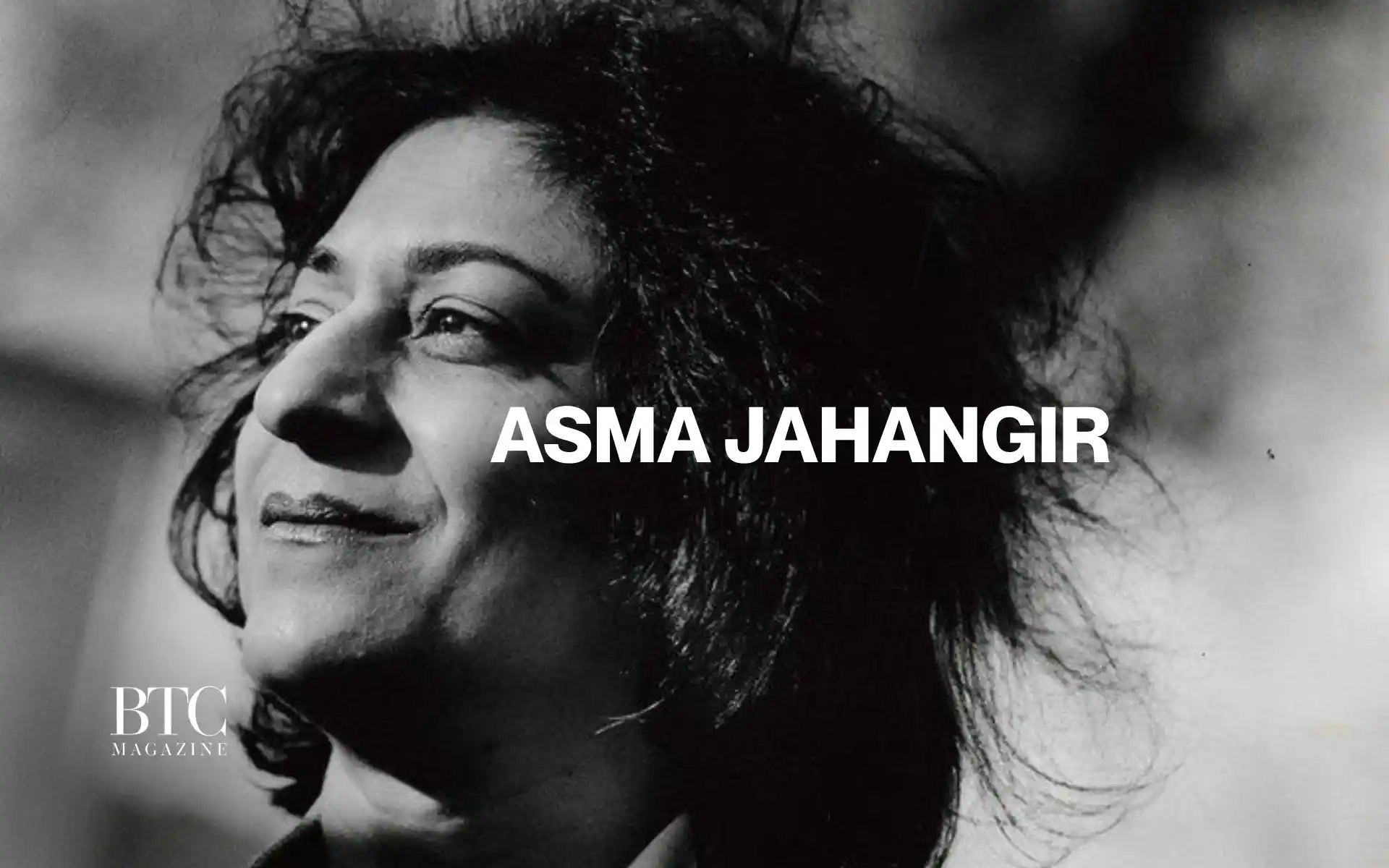
Every rebellion needs an origin story. Asma Jahangir is Pakistan’s.
At 18, she marched to the Supreme Court to demand her father’s release from military detention. He had been imprisoned for speaking against the government’s actions in East Pakistan, what the world would later recognize as genocide in Bangladesh. Most teenagers wouldn’t know where to begin. Asma filed a petition.
She won.
That victory, Asma Jilani v. Government of Punjab, became a landmark constitutional case. It established that even military governments could not detain citizens without legal justification. She was barely an adult, and she had already handed the Pakistani state its first lesson in accountability.
She never stopped teaching.
In 1980, Asma and her sister Hina Jilani founded AGHS Legal Aid Cell, Pakistan’s first law firm run entirely by women. Their clients were the people everyone else refused: Christians facing death sentences under blasphemy laws. Women accused of adultery for being raped. Bonded laborers. Teenagers on death row. The voiceless, the erased, the inconvenient.
She co-founded the Human Rights Commission of Pakistan. She co-founded the Women’s Action Forum. She became the first woman elected President of the Supreme Court Bar Association in 2010, after decades of men telling her she didn’t belong in courtrooms at all.
The United Nations appointed her Special Rapporteur on Extrajudicial Executions, then Special Rapporteur on Freedom of Religion. She investigated human rights abuses in Sri Lanka, Israeli settlements, and Iran. She stood on international stages and said what needed saying, even when governments wanted her silent.
Especially then.
In 1983, police beat, tear-gassed, and arrested Asma during protests against laws that reduced a woman’s legal testimony to half a man’s. She was imprisoned. Then placed under house arrest. Then imprisoned again.
In 1995, she defended two Christian teenagers accused of blasphemy. Mobs surrounded the courthouse. They smashed her car. They threatened her children. She sent her children abroad to keep them safe, and kept showing up to court.
In 1999, a gunman walked into her office and shot a client dead. The bullet missed Hina by inches. The client, Samia Imran, had come seeking help to escape an abusive marriage. Her own family had ordered the killing.
Asma didn’t stop taking cases.
In 2007, Pervez Musharraf declared emergency rule and had her detained. She spent months under house arrest. In 2012, U.S. intelligence uncovered a plot by Pakistani security officials to have her assassinated.
She kept going.
Asma Jahangir didn’t just challenge laws. She challenged the assumption that laws were unchallengeable.
She defended people accused of blasphemy in a country where that accusation is a death sentence, social if not legal. She fought honor killings when the culture called them tradition. She represented women accused of adultery for the crime of being raped, then watched courts overturn unjust verdicts because she refused to let them stand.
She made rebellion look possible.
Every woman in Pakistan who starts a business, builds a platform, or speaks without permission is walking a path Asma cleared. She didn’t do it politely. She didn’t do it quietly. She did it while governments tried to silence her, mobs tried to kill her, and critics called her a traitor.
“I cannot bear to live where there is so much injustice and I cannot do something about it,” she once said. “What kind of a torturous life is that?”
Asma Jahangir died of a heart attack on February 11, 2018. She was 66. The day before, she had spoken at a protest demanding justice for a young Pashtun man killed by police. She called the detained children of Swat “her own kids.” She was still fighting.
Her name means world conqueror. Her legacy is simpler, and fiercer: she proved that one woman’s refusal to accept injustice can reshape what an entire nation believes is possible.
Aleena Mohsin Mughal builds ethical fashion empires.
Shameelah Ismail restructures who gets to earn.
Myra Qureshi dismantles toxic beauty standards through market power.
They stand on ground Asma Jahangir broke open with her bare hands.
She said no first. She said no loudest. And she never, ever stopped.
Members only from here
You've reached the preview. Subscribe for the full article — plus every issue and subscriber perks.
7-day free trial, then from $3.99/mo. Cancel anytime.
Instant access · Cancel anytime
“I started reading for the fashion pieces, but the essays are what kept me coming back.”
Maya R. · Toronto reader
Asma Jahangir is one of Pakistan's most important human rights lawyers and activists. At 18 she marched to the Supreme Court to demand her father's release from military detention and won a landmark constitutional case establishing that even military governments could not detain citizens without legal justification. She went on to found Pakistan's first all-women law firm, co-found the Human Rights Commission of Pakistan, and become the first woman elected president of the Supreme Court Bar Association.
Through AGHS Legal Aid Cell, Jahangir and her sister Hina Jilani represented Christians facing death sentences under blasphemy laws, women accused of adultery for being raped, bonded laborers, and teenagers on death row. These were clients the legal system was designed to erase. Taking their cases was not just advocacy but a direct challenge to the laws enabling their persecution.
In 1983 police beat, tear-gassed, and arrested her during protests against Zia ul-Haq's dictatorship. Jahangir faced death threats, house arrest, and international pressure to silence her throughout her career. She refused consistently. Her response to the state's attempts to intimidate her became part of what made her the origin story the article names her as.
Keep exploring
Read the full story
7-day free trial · From $3.99/mo
Discover every article featured in our latest BTC issues, bringing the month's stories together in one place, so you can easily read and explore everything.
Read Now →Skin has no pronouns, and neither does great skincare. Discover clean beauty made for every skin type, age, and identity. Honest formulas, clear ingredients, and inclusive beauty that actually belongs to you.
Clean beauty for skin, not labels. Face mists, serums, moisturizers, and masks made for you, whoever you are.
Colour makeup and body care that work with your skin, not against it. Inclusive beauty, made honestly.
Beauty gifts and skincare gifts, curated into sets your favourite person will actually use and love.
You deserve stories that actually get you. A BTC magazine subscription unlocks unlimited access to in-depth, unfiltered articles, exclusive podcasts, and member perks you'll genuinely love. Try it free for seven days, then keep enjoying full access from just $3.99 a month. Cancel anytime, no pressure at all. Ready to go deeper?
7-day free trial, then from $3.99/mo. Cancel anytime.

.webp)
.webp)
Comments
No comments yet
No comments to show yet. Subscribe to join the conversation.
Log in or subscribe to comment on this article.