
Available on iOS & Android
Read BTC Anywhere
Carry the full magazine experience in your pocket — stories, podcasts, exclusive perks, and more. Download the free app today.
Carry the full magazine experience in your pocket — stories, podcasts, exclusive perks, and more. Download the free app today.
I remember the kitchen long before I understood power.
I was eight or nine, old enough to read a room and know when something mattered.
After the holiday meal, after plates were cleared and the men retreated to the living room, loosening belts, turning on the television, the women gathered.
My aunts. My nonna. Sisters and sisters-in-law.
I didn’t yet have language for what I was witnessing, but I understood it intuitively.
There was warmth. Ease.
A rhythm.
And the most beautiful sense of unspoken belonging.
Hands moved instinctively, drying dishes, pouring coffee, touching shoulders in passing. Stories overlapped and made sense. Complaints softened into laughter. Support appeared without being asked.
I was told the men held the power. And externally, they did. But even then, I sensed something deeper unfolding in that kitchen.
The women held a different kind of power.
Not the kind that announces itself, but the kind that sustains life. The kind that makes magic.
There were trays of food everywhere. Mountains of it. Platters of pasta. Roasted meats. Loaves of bread still warm. Cannoli dusted with sugar. Biscotti. Amaretti. Fig cookies. Things appearing faster than they could possibly have been made.
Creation never stopped.
And the women orchestrated it all without urgency or chaos, guided by an embodied knowing passed down through generations.
It was creative power in motion and it didn’t control, It held us all.
I didn’t know it then, but I was witnessing a way of being that would later become my work in the world.
Women building real community, organically, relationally, without performance.
And I would spend much of my life trying to understand how we lost it. Because when I went out into the world, it was nothing like the kitchen.
The first real rupture came early, as a young dancer in New York City. People like to romanticize that time. They talk about grit, hustle, the city that sharpens you and it was all that.
But it wasn’t the city that bit the hardest.
It was the other women.
Standing in studios beside other female dancers, I remember thinking: Surely we’re navigating the same fears, the same longing to be seen and chosen.
And yet, the system made sure we rarely met as allies.
Auditions were thick with tension.
Eyes scanned bodies instead of meeting faces.
Of course, this was Martha Graham’s School of Contemporary Dance, the top in the world at the time so high competition was expected. That wasn’t the shock.
What surprised me was something deeper.
Teachers studied my technique. Other female dancers studied my body, as if comparison might steal them a sliver of edge, a fragile sense of superiority.
I began dissecting myself hoping that relentless self-criticism might earn me entry. Were my breasts too full beside the narrow lines of the classical ballerina? Did I have too much curve, not enough? Could I survive on coffee, cigarettes, and a single cannoli from my favorite bakery, and somehow belong again?
Competition everywhere, not just for roles, but for visibility, validation, worth. Always Imposed from the outside.
Never arising from within.
This was my first clear lesson in how women adapt.
We have the uncanny ability to walk into a room and read it instantly, like speed-reading energy. Where’s the authority? What is rewarded? Can I shine here or should I shrink just in case people think I’m too much? You can walk out of your house feeling great, and then walk into a room full of women and all it takes is that one woman, that tone-setter who seemingly has it all together and boom… you’re picking your self confidence off the bathroom floor.
And then we shapeshift.
This is our brilliant skill.
And… It’s also how we lose ourselves.
Later, when I moved to Greece, I thought, Surely here, the birthplace of the goddess holds the golden key.
But even there, modern life had already done its harm.
I was older now, married, building my business in a foreign country. I assumed that someone would simply say, Yes. I’ve felt that too. You’re not alone.
They didn’t.
Then came motherhood and a community with other mothers.
I thought: Here. This must be it. Women raising children. Sharing purpose. Wanting the same simple thing, to raise good kids. And yet, even here, the same undercurrent.
Smiles on the surface.
Judgment underneath.
Comparison disguised as cordial concern.
Competition over whose child was thriving, whose marriage was intact, whose life looked most “together.”
It’s rarely blatant. It lives in the undertone, the glance that carries judgment and lands squarely in the chest. The sideways smile that silently says, Is that what you chose to wear?
And just as I had once been the observer in that kitchen, I became the observer here too.
Over fourteen years of coaching women, I’ve watched this pattern repeat across cultures, incomes, and identities.
This is why I do this work.
Because the wound is not theoretical.
It is still lived.
And it keeps women divided.
Of course, not ALL women do this.
Many women do create real communities. They understand relational safety. They don’t posture, perform, or compete.
But they are not the squeaky wheel.
And for the sake of what goes too often unnamed, we have to oil the squeaky wheel, because silence is how this sisterhood wound survives.
What I understand now, and what I couldn’t have named then, is that our kind of power has always made dominant systems uneasy, because it couldn’t be controlled or hierarchized.
Women practice power with, not power over.
The power I witnessed in that kitchen didn’t move through force or command. It moved through attunement. Through coordination. Through an intelligence that didn’t announce itself and didn’t need permission.
And systems built on domination have always feared what they cannot fully comprehend or regulate.
So I’m just going to come right out and say it.
Women competing against one another is not intrinsic to our nature.
It is not biological.
It is not inevitable.
It was created by design.
Women were taught to compete by patriarchy, and then it was enforced through religion, capitalism, corporate systems, and cultural media.
Religion taught women that virtue was scarce.
There were good women and fallen women. And god forbid you were labelled the latter. Chosen women and warned-against women.
Purity became currency.
Obedience became our safety. The ‘good girl’ syndrome still leaks through our modern society like water gushing from a faucet.
Capitalism refined the lesson, It taught women that worth must be visible, measurable, marketable, and only a few lead roles were available at the table with the men.
Corporate systems sealed it in place. Women were welcomed only on the condition that we succeed by masculine rules.
Media made it cultural.
It turned women into constant commentary.
Bodies ranked against bodies.
Motherhood measured against motherhood.
Ambition weighed and judged.
Sexuality surveilled, praised, or punished.
We didn’t just absorb these messages.
We internalized them.
Since we’re naming what has long gone unnamed, we gotta just go there. Patriarchy and capitalism profit from women divided because division is diversion.
When women are busy competing with each other, they are not organizing. When they had to fight to earn the right to open their own bank accounts, they were not questioning systems. It took decades, in some places nearly a century, for women to win the right to vote.
But fighting to be included inside a system is not the same as redesigning it. A woman struggling for access rarely has the bandwidth to build something different. And division ensures she keeps struggling.
Capitalism profits because comparison keeps women consuming.
Patriarchy profits because competition keeps women from forming collective organizing.
A woman gets promoted, and other women question how she got there instead of questioning why leadership remains male-dominated.
A woman raises her prices, and other women call her arrogant or out of touch instead of asking why women’s labor is chronically undervalued.
A woman sets boundaries, and she’s labeled difficult, often by women who are exhausted from not setting any boundaries themselves.
A woman becomes visible in her power, and the response isn’t curiosity, it’s quiet resentment: Who does she think she is?
Some of the deepest wounds women carry did not just come from men.
They came from other women enforcing the same hierarchy.
That is a hard pill to swallow.
But a necessary one.
I’ve watched this dynamic unfold in dance studios, motherhood circles, entrepreneurial masterminds, and empowerment spaces alike.
At first, the room is polite. Women arrive warm, articulate, self-aware. They speak about growth and healing. They nod at the right moments.
But if you stay long enough, if you listen beneath the words, something else emerges. A tightening.
Support offered publicly gets withdrawn privately.
Praise followed by distancing and who said ghosting only happens on dating sites! Collaboration does get discussed but never really enacted.
The outward smile… but do we ever know what they really think of us? And that question can keep many of us up at night, questioning our judgement and our worth.
We have been trained to be alert around one another.
The system taught us: If she wins, I lose.
Much of what we call empowerment today teaches women how to win inside the very system that asked us to betray ourselves in order to survive.
It rewards visibility, polish, and rhetoric, not truth.
It celebrates resilience without asking what broke us in the first place.
It praises strength while quietly discouraging our softness.
It looks powerful.
But it often requires self-betrayal to maintain.
This is why, in my work, I ask every woman this same question:
Is this who you really are, or who you had to become to survive?
Because we have become very good at looking the part.
So good that when we are finally alone, without roles, without mirrors, without performance, we don’t always recognize ourselves.
When I ran women’s meets and our theme was relationships, very few times would a woman say out loud that she wanted to throw her hubby off the cliff that morning. The fear of being judged for having conflict in your marriage was too unbearable. But, in private- I’d get the call… can I come see you … I really feel broken. And that’s the real heartbreak we can no longer accept.
So where do we go from here?
We reconnect.
We return to our intuition and learn to trust it again.
We stop mistaking hardness for strength and remember that real leadership comes from being internally steady and uniquely expressed.
Women are master adapters. That has always been our gift.
But when we adapt to the wrong architecture long enough, we forget who we were before the mask. It might look like a beautiful Venetian Ball mask, but a mask is still a mask.
This is not a call to be nicer.
It is a call to stop contorting ourselves to belong.
This is not a revolution in the traditional sense.
It is a revelation. Inside each woman. A remembering.
I think back to that kitchen.
Those women didn’t talk about power. They didn’t fight their way to the top. Yes, they bickered with each other, but the communal bond was always the trophy, and that is the real beauty of a woman’s power.
The kitchen taught me something patriarchy wants us to forget: women’s power isn’t scarce. It multiplies through connection. And when we refuse to compete, when we withdraw consent from a system that needs us divided, we don’t just change ourselves. We change who gets to hold power.
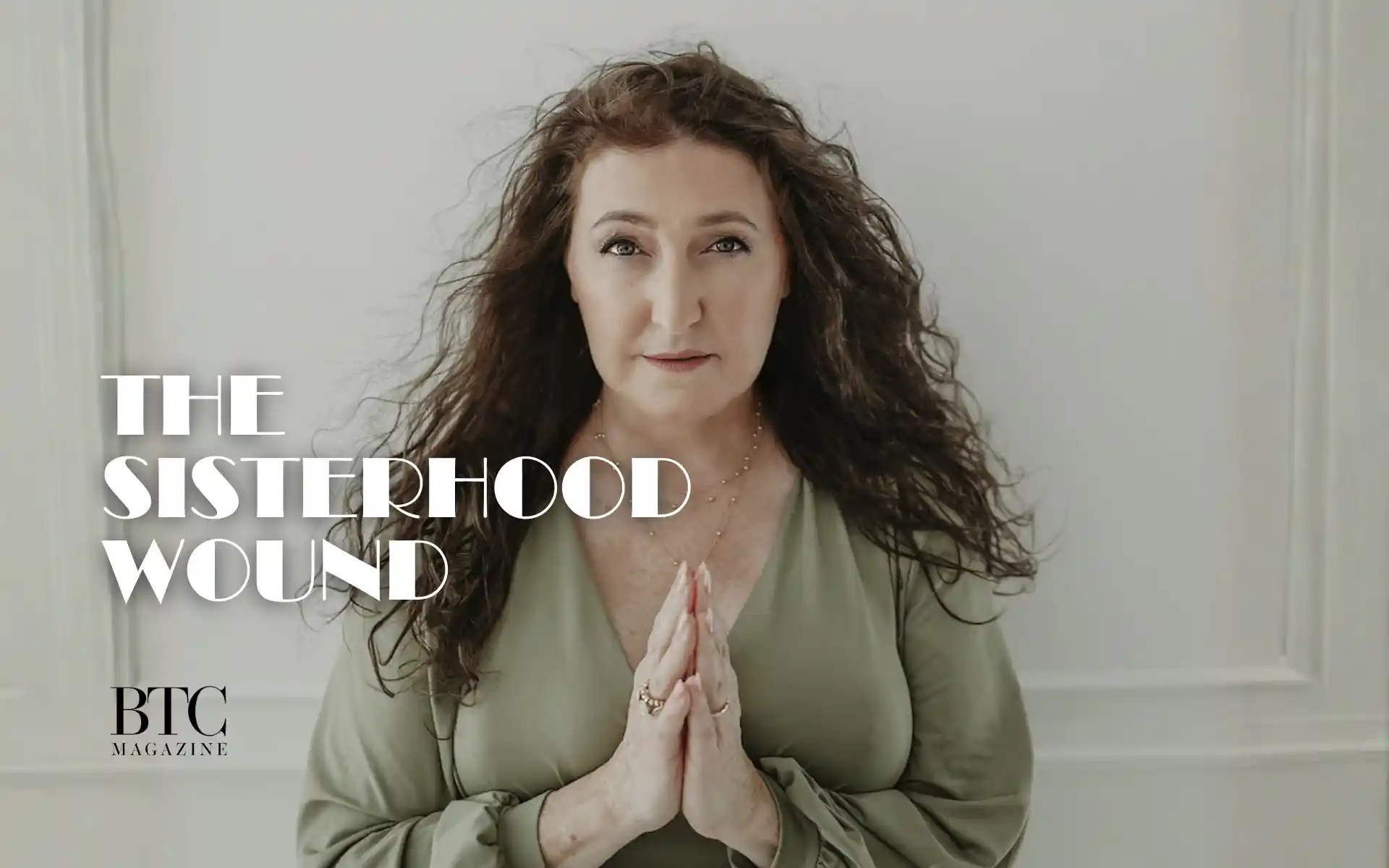
Josephine Carmela is the founder of The Aligned Woman and an award-winning Feminine Leadership Mentor and somatic practitioner whose work bridges embodiment, nervous-system science, and spiritual psychology. For over fourteen years, she has guided women to distinguish who they truly are from who they had to become to survive, restoring intuitive authority, relational power, and leadership rooted in their own truth over performance. www.bethealignedwoman.com
Members only from here
You've reached the preview. Subscribe for the full article — plus every issue and subscriber perks.
7-day free trial, then from $3.99/mo. Cancel anytime.
Instant access · Cancel anytime
“I started reading for the fashion pieces, but the essays are what kept me coming back.”
Maya R. · Toronto reader
The sisterhood wound is the pattern of competition, comparison, and undermining between women that appears personal but is actually structural. It describes how women who have been trained to compete for scarce resources, approval, and safety in patriarchal systems turn that competition on each other. The wound is not that women are naturally competitive but that the system made competition the survival strategy.
The writer as an eight-year-old watched her aunts, nonna, and sisters-in-law orchestrate an entire holiday meal with effortless coordination: warmth, rhythm, unspoken belonging. The men held external power but the women held what sustained life. That kitchen memory became the foundation of the writer's work in women's leadership, a model of power that creates without controlling.
When women compete over the limited slots that patriarchal systems offer, they police each other's appearance, choices, and ambition in ways that protect the system rather than each other. Josephine Carmela's work as a feminine leadership mentor addresses this directly: the wound heals not through individual performance but through understanding that scarcity was imposed rather than real.
Keep exploring
Read the full story
7-day free trial · From $3.99/mo
Discover every article featured in our latest BTC issues, bringing the month's stories together in one place, so you can easily read and explore everything.
Read Now →Skin has no pronouns, and neither does great skincare. Discover clean beauty made for every skin type, age, and identity. Honest formulas, clear ingredients, and inclusive beauty that actually belongs to you.
Clean beauty for skin, not labels. Face mists, serums, moisturizers, and masks made for you, whoever you are.
Colour makeup and body care that work with your skin, not against it. Inclusive beauty, made honestly.
Beauty gifts and skincare gifts, curated into sets your favourite person will actually use and love.
You deserve stories that actually get you. A BTC magazine subscription unlocks unlimited access to in-depth, unfiltered articles, exclusive podcasts, and member perks you'll genuinely love. Try it free for seven days, then keep enjoying full access from just $3.99 a month. Cancel anytime, no pressure at all. Ready to go deeper?
7-day free trial, then from $3.99/mo. Cancel anytime.
Comments
No comments yet
No comments to show yet. Subscribe to join the conversation.
Log in or subscribe to comment on this article.