
Available on iOS & Android
Read BTC Anywhere
Carry the full magazine experience in your pocket — stories, podcasts, exclusive perks, and more. Download the free app today.
Carry the full magazine experience in your pocket — stories, podcasts, exclusive perks, and more. Download the free app today.
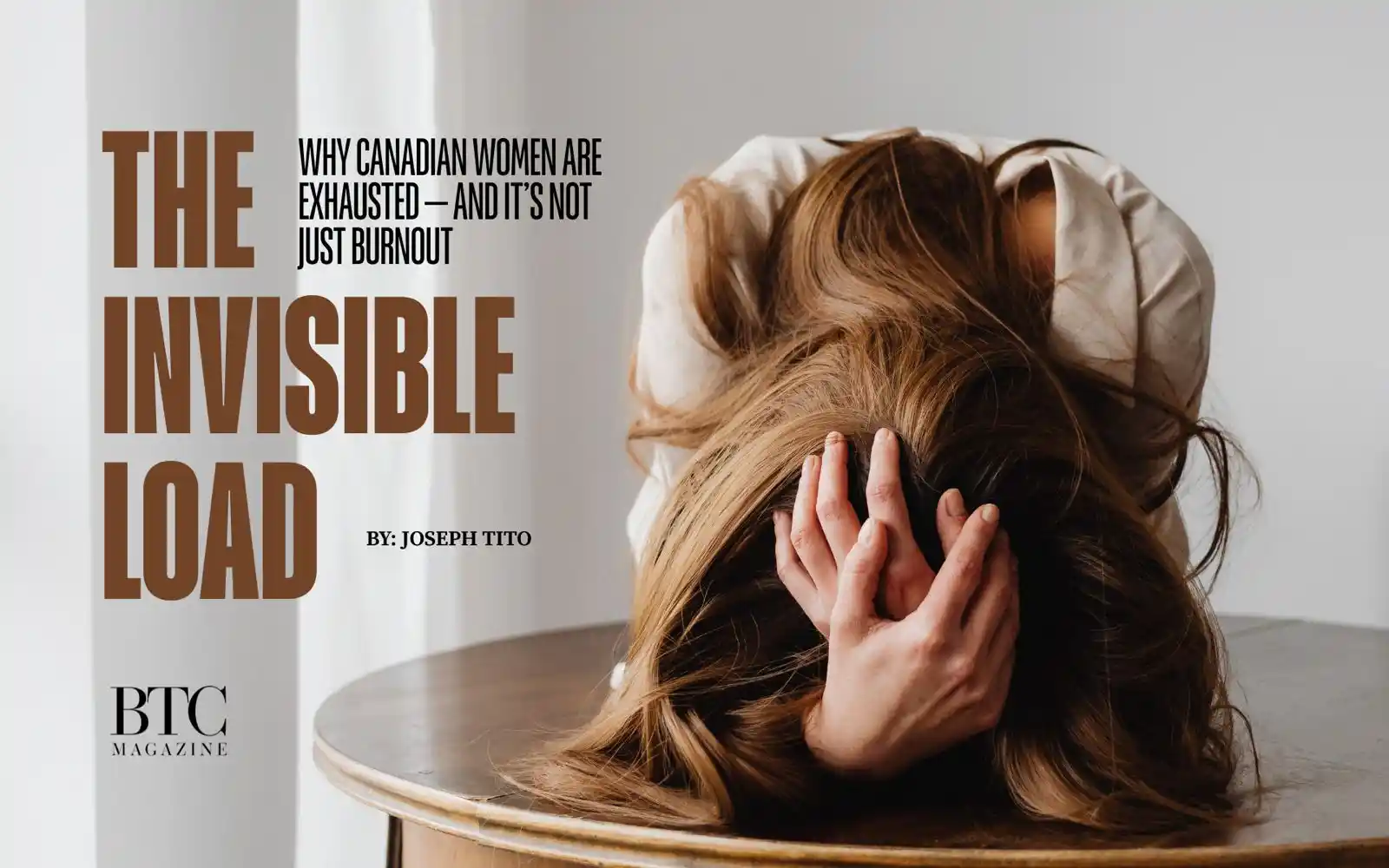
There’s a kind of tired that sleep doesn’t fix.
It doesn’t show up on a Fitbit. It doesn’t disappear after a weekend away. It’s the exhaustion that sits quietly behind your eyes while your brain keeps running inventory long after the house has gone still, dentist appointments, permission slips, groceries, who’s emotionally off, who needs new boots, who hasn’t called their mother.
If you’re a woman in Canada right now, especially between 30 and 55, you’re likely carrying more than anyone realizes.
And it’s not because you’re bad at balance.
It’s because the system quietly expects you to absorb everything.
We call it “the mental load” as if it’s a trend, a neat little infographic that lives on social media. But according to Statistics Canada, women continue to perform more unpaid domestic and caregiving labour than men, even in dual-income households where both partners work full-time.
Both work.
One still manages the invisible.
And here’s the truth no one says out loud: women aren’t asking for help. They’re asking for relief.
There’s a difference.
Across the country, a generation of women is quietly cracking under the weight of simultaneous roles. Many are raising children while caring for aging parents. They’re navigating teen anxiety and eldercare logistics, corporate deadlines and shifting hormones. Perimenopause arrives at the same time as career peaks. Parents begin declining just as kids need more emotional presence. Mortgages are larger. Groceries are more expensive. Time feels thinner.
And somehow she is supposed to feel grateful.
Grateful she “has it all.”
But having it all without structural support doesn’t feel empowering. It feels like drowning in a beautiful house.
This is not a bubble bath problem. It isn’t solved with candles or a weekend spa escape. The Canadian Mental Health Association continues to report rising levels of stress and anxiety among women balancing work and caregiving responsibilities. The pressure isn’t imagined. It’s measurable.
Yet women internalize it anyway.
If I were more organized.
If I were calmer.
If I just tried harder.
No.
You are not failing.
The structure is.
What makes it heavier is the loneliness inside full houses. Many women feel isolated not because they lack partners or families, but because they are the emotional project managers of everyone’s lives. They carry the logistics and the temperature of the room. They sense the shifts before anyone else does.
When was the last time someone looked at you and asked, without rushing, “What’s heavy for you right now?”
Not what’s for dinner.
Not what time practice starts.
Not whether the laundry is done.
But you.
That quiet gap, between what you carry and what is acknowledged, is where resentment grows.
So what do we do?
We stop romanticizing resilience as a personality trait. We stop applauding women for “doing it all” while silently handing them more. We begin redistributing the invisible. We ask honest questions inside our own homes: Who carries what here? What can be dropped? What actually matters?
Members only from here
You've reached the preview. Subscribe for the full article — plus every issue and subscriber perks.
7-day free trial, then from $3.99/mo. Cancel anytime.
Instant access · Cancel anytime
“I started reading for the fashion pieces, but the essays are what kept me coming back.”
Maya R. · Toronto reader
The invisible load is the constant background management of everyone else's needs: dentist appointments, permission slips, emotional check-ins, who needs new boots, who hasn't called their mother. Statistics Canada data confirms that women perform more unpaid domestic and caregiving labor than men even in dual-income households where both partners work full-time. Both work. One still manages the invisible.
It's the kind of tired that sleep doesn't fix. It doesn't show up on a fitness tracker. A weekend away doesn't touch it because it lives in the structural expectation that women will absorb everything the household and caregiving system produces without being acknowledged for doing so. The article calls it drowning in a beautiful house.
Perimenopause typically arrives at the same time women are carrying peak career, peak caregiving for aging parents, and peak involvement in their children's emotional development. The hormonal transition lands on a nervous system that has been running on empty for years, which is why the compound exhaustion feels categorically different from simply being busy.
Keep exploring
Read the full story
7-day free trial · From $3.99/mo
Discover every article featured in our latest BTC issues, bringing the month's stories together in one place, so you can easily read and explore everything.
Read Now →Skin has no pronouns, and neither does great skincare. Discover clean beauty made for every skin type, age, and identity. Honest formulas, clear ingredients, and inclusive beauty that actually belongs to you.
Clean beauty for skin, not labels. Face mists, serums, moisturizers, and masks made for you, whoever you are.
Colour makeup and body care that work with your skin, not against it. Inclusive beauty, made honestly.
Beauty gifts and skincare gifts, curated into sets your favourite person will actually use and love.
You deserve stories that actually get you. A BTC magazine subscription unlocks unlimited access to in-depth, unfiltered articles, exclusive podcasts, and member perks you'll genuinely love. Try it free for seven days, then keep enjoying full access from just $3.99 a month. Cancel anytime, no pressure at all. Ready to go deeper?
7-day free trial, then from $3.99/mo. Cancel anytime.
.webp)



Comments
No comments yet
No comments to show yet. Subscribe to join the conversation.
Log in or subscribe to comment on this article.