
Available on iOS & Android
Read BTC Anywhere
Carry the full magazine experience in your pocket — stories, podcasts, exclusive perks, and more. Download the free app today.
Carry the full magazine experience in your pocket — stories, podcasts, exclusive perks, and more. Download the free app today.
How Joanna Johnson built a revolution from the wreckage of everything she thought she knew
The revolution wasn't supposed to start with TikTok dances.
Joanna Johnson was lip-syncing to "Jesse's Got a Gun" in her empty house, buying guitars she couldn't play, performing for strangers on an app she didn't understand. Her friends were calling to check if she was having a breakdown. She was 44, recently divorced, trapped in lockdown, and according to every metric that had previously defined her life, completely lost.
"My friends were calling me, making sure I wasn't having a physical, emotional breakdown," she laughs, remembering those early pandemic days. "They kept asking, 'What is going on, Joanna?' What they were seeing, and I didn't know it then, was very much a level of authenticity."
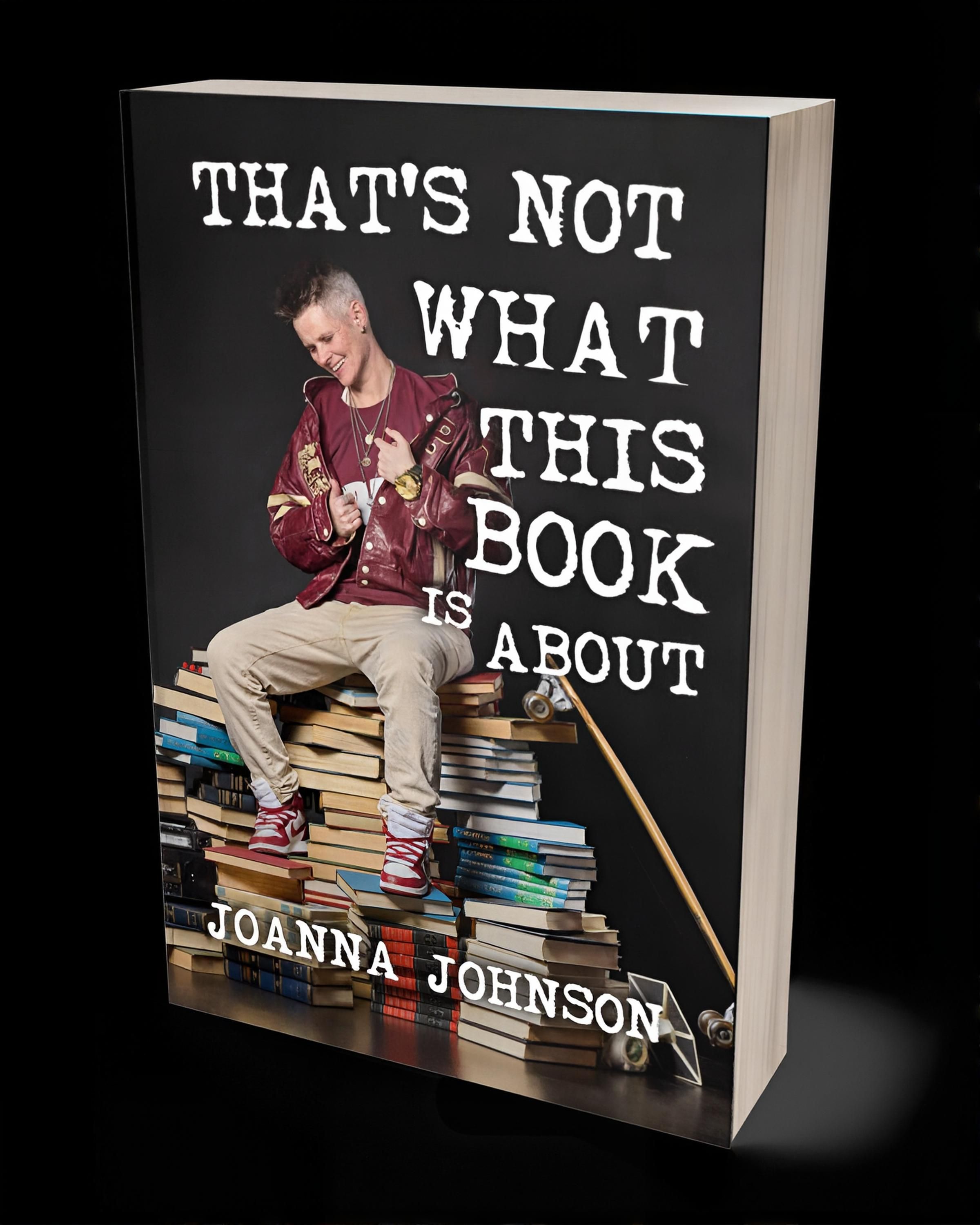
Three years later, that "breakdown" has become a movement. The Ajax, Ontario educator now has over 3 million followers who look to @unlearn16 for wisdom about identity, authenticity, and the courage to rebuild your life from scratch. Her memoir, "That's Not What This Book Is About," is a number one bestseller. She's a keynote speaker, a school vice principal, and, most surprisingly to her, someone millions of people turn to when they need permission to become who they really are.
But here's what makes Joanna different from every other inspiration-peddling influencer: she's brutally honest about the fact that she's still figuring it out.
The Perfect Storm
The path to viral educator began with what Joanna calls "three things occurring at the moment in time to create the perfect storm: Divorce, COVID lockdown, and Charlie, my best friend's kid, persuading me to download the app."
The divorce came first. After years of what she now recognizes as dimming herself, "not being the center of the room, not being the person on stage, just carrying the stuff, being in the background", her marriage ended. But the real end, the soul moment, came later.
"There was a moment that I stopped being her person," she says, her voice quieting. "She would call often, especially very late at night, very upset, questioning, needing support, and there was a moment that I had the awareness to say, 'I'm not your person anymore.'"
It was 3 AM. A friend had told her she was still only "75% out" of the relationship. "That was the moment I knew that if I continue trying to save you, I'm never going to be the person that I need to be. And even worse, I'm never going to, even if you wanted me to save you, I can't. One person can't save another."
What's remarkable is how little of herself she had to grieve. "I had been packing away myself for a good chunk of that relationship. I'd been just dimming it, right? As soon as you have to go somewhere and be less to make them feel better..." She trails off, then adds with characteristic directness: "I wasn't being myself at all. I was limiting who I was, and by limiting who I was, I was standing still."
Standing still wasn't an option during lockdown. Alone in her house with nowhere to go and no one to dim herself for, Joanna had to face who she actually was. Social media became an unlikely laboratory for authenticity.
"I accidentally said something about Doug Ford," she recalls. "Literally, I just blurted it out, and then people were responding. They were laughing and saying, 'Oh my God, you're so bang on!' That's when I realized people want to talk about things authentically."
The platform grew because Joanna brought something radical to social media: the willingness to admit she didn't have all the answers while still standing firmly in her truth. Her approach to bigotry and hate comments reveals this perfectly.
"You can't talk to hate, but I assure you, ignorance can be educated," she explains. When trolls comment about her appearance or sexuality, she responds with curiosity rather than defensiveness. "People ask, 'How do you keep your cool?' I say, 'I just don't care. Here’s a guy that spelled ‘their’ wrong wrong. What do I care about this guy?'"
But it's not sociopathy, it's privilege, and she knows it. "I've had the luxury of living a privileged life in the sense that it's not that I've never experienced homophobia or roadblocks, but nothing horrific. I'm not carrying trauma. So when people authentically ask, 'Are you a boy or a girl?' I can authentically have that conversation without it triggering something significant."
The Teaching Paradox
Here's where it gets complicated: How do you teach kids to be authentic when you're still figuring out who the hell you are?
"You lead with that, don't you?" Joanna says without hesitation. "You lead with 'I don't know.'"
After 23 years of teaching, she's learned that the education system has it backwards. "I try to tell kids, do things that scare you, do things you're not good at, because those are the things that are really going to highlight when you have to dig down. If I was good at math, just taking math course after math course teaches me nothing. Being afraid but doing it anyway, that's going to teach you something."
She practices what she preaches. Five years ago, after decades of refusing, she finally agreed to be in a school play. "I've never been so scared in my entire life ever," she admits. "The best part was I had students that I was teaching strategies to study history, calming me down and helping me go through a completely different skill set."
The LGBTQ+ advocacy that has become central to her platform works the same way. She's not trying to convert anyone or have dramatic coming-out conversations with students. Instead, she exists openly, loudly, authentically, "a visual example of somebody living very openly, very loudly, very 'call me whatever you want, just as long as you compliment my hair', so that they can see that when they go down their authentic road, they can have a good, happy, healthy life."
When millions of people look to you for guidance, what happens when you don't feel wise?
"Every day," Joanna laughs. "What happens when I don't feel wise? Every day."
But here's her secret: "As soon as you know that you know nothing, I think there's a comfort in it. I think the wisdom comes from understanding you have relatively nothing on lock, but you're willing to try everything."
This Socratic approach extends to her online presence, where she navigates the impossible balance between authentic and performative. "I am performative. If I wasn't, I couldn't be a teacher," she acknowledges. "You don't get the message across unless you keep somebody's attention. If I don't keep a 16-year-old's attention, I don't care, it doesn't matter what knowledge I have in my head."
The difference is intention. On TikTok, every gesture is amplified because she's trying to hold attention for four or five minutes. On live streams, she's more natural because there's back-and-forth conversation. But the core message remains the same: be willing to be scared and do it anyway.
Love After Superman
The hardest comment Joanna receives isn't about her appearance or politics, it's when the right wing successfully conflates LGBTQ+ advocacy with the term "groomer."
"Everybody has a guttural reaction, you want to throw up when you think about people taking advantage of or manipulating kids. And they've done such a horrifically good job at binding the two together that it makes it very hard to operate in that space."
She refuses to repost such comments, even to discredit them, because "then you're adding to it." Instead, she focuses on what she can control: being an example and having authentic conversations when possible.
This approach extends to her personal life. After years of playing "Superman" in her marriage, swooping in to rescue and fix, she had to learn an entirely different way to love when she met Ana.
"I luckily met somebody who didn't need nor want me to save them," she explains. "Ana said, 'No, no, I don't need you to do that. That's me. I'll take care of me. You take care of you.' We've had to have more than one conversation like that where I realized, 'Oh, my value doesn't come from making sure you're okay because you're making sure you're okay.'"
The realization was profound: "If I would have met the wrong person, I would be in the exact same loop."
What terrifies someone who has rebuilt their entire life? "Failing," Joanna says simply. But not in the way you might think.
As a vice principal, she carries the weight of wanting to help every student who walks through her door. "I tend to try to think, probably sometimes with a little bit of hubris, that I can help. And I always fear that one kid that I can't."
Her office reflects this philosophy, movie posters, pop culture references, things that make people feel comfortable enough to be real. "The more we can connect through those kinds of stories, the more authentic the relationship is."
But success? She already feels like she's made it. "I'm good now," she says with characteristic directness. Though she has one big goal left: filling Massey Hall with people who want to have the kinds of authentic, difficult, necessary conversations that social media has proven people are hungry for.
The Unlearning
For readers who feel stuck, who look at their lives and think "this isn't working but I don't know how to burn it down," Joanna has surprising advice: Don't.
"I don't know if I'd start with burning it down. I'd start with one thing, one thing that you want to do that you're terrified to do. It could be an acting class, it could be scuba diving, it could be writing a book. You start engaging in it in an authentic way. You don't have to burn everything down because everything else will just fall away."
The key is recognizing what you've been carrying that was never yours to carry. "We need to recognize that you have to stop carrying that. You have to figure out -
what can I put down? My 14-year-old can get their own lunch. I can go do the art class. We don't have to do everything together."
Because here's the truth she's learned: "You can't make other people happy. You can't fulfill other people. You can't make other people feel whole and powerful. You can only do that for you. And the more you do that for you, people around you will say, 'Oh shit, I want that. I'm going to do that.'"
If all of it disappeared tomorrow, the followers, the speaking engagements, the platform, what would remain of who Joanna really is?
"It would all remain," she says without hesitation. "The connections that I've made, the idea that I could go into any business, shake hands with any person at this point, never feel that I was out of place, never feel that I couldn't belong, that would remain. The idea that I'll be scared but I'll do it anyway. That, I hope, stays."
This is what makes Joanna's story so powerful: it's not about finding yourself through external validation. It's about finally stopping the performance of being less than you are and discovering that who you've always been is enough.
Her book isn't really about the stories from her childhood, though they're there. It's not about becoming a viral sensation, though that happened. It's about the moment when you stop being who you think you should be and start being who you actually are.
And sometimes, just sometimes, the world is ready for exactly that person.
"That's not what this book is about," she says, grinning. "But maybe that's exactly what this life is about."
Members only from here
You've reached the preview. Subscribe for the full article — plus every issue and subscriber perks.
7-day free trial, then from $3.99/mo. Cancel anytime.
Instant access · Cancel anytime
“I started reading for the fashion pieces, but the essays are what kept me coming back.”
Maya R. · Toronto reader
Joanna Johnson is an Ajax, Ontario educator and school vice principal who went viral under the handle @unlearn16 after posting TikTok content during COVID lockdown while going through a divorce. What friends saw as a potential breakdown, Joanna now recognizes as an emergence of authenticity. She has grown to over 3 million followers who look to her for wisdom about identity and rebuilding after loss.
The memoir is a number one bestseller that documents Joanna's path from a constrained version of herself through divorce, lockdown, and viral unexpectedness toward a life built on authentic identity rather than inherited expectations. It's also the source of her keynote speaking work, rooted in the idea that millions of people are looking for permission to become who they really are.
Three things converged simultaneously: her divorce, the COVID lockdown, and a teenager named Charlie persuading her to download TikTok. Without all three arriving at once, the lip-sync videos that began her second act probably wouldn't have happened. Joanna describes the combination as the conditions that made authenticity unavoidable.
The core of her work is that rebuilding from scratch requires willingness to question everything you thought defined you. She is honest about still figuring it out herself rather than presenting as someone who has it solved, which is part of why her following trusts her. The permission she gives millions of people is rooted in her own ongoing process.
Keep exploring
Read the full story
7-day free trial · From $3.99/mo
Discover every article featured in our latest BTC issues, bringing the month's stories together in one place, so you can easily read and explore everything.
Read Now →Skin has no pronouns, and neither does great skincare. Discover clean beauty made for every skin type, age, and identity. Honest formulas, clear ingredients, and inclusive beauty that actually belongs to you.
Clean beauty for skin, not labels. Face mists, serums, moisturizers, and masks made for you, whoever you are.
Colour makeup and body care that work with your skin, not against it. Inclusive beauty, made honestly.
Beauty gifts and skincare gifts, curated into sets your favourite person will actually use and love.
You deserve stories that actually get you. A BTC magazine subscription unlocks unlimited access to in-depth, unfiltered articles, exclusive podcasts, and member perks you'll genuinely love. Try it free for seven days, then keep enjoying full access from just $3.99 a month. Cancel anytime, no pressure at all. Ready to go deeper?
7-day free trial, then from $3.99/mo. Cancel anytime.

.webp)
Comments
No comments yet
No comments to show yet. Subscribe to join the conversation.
Log in or subscribe to comment on this article.