
Available on iOS & Android
Read BTC Anywhere
Carry the full magazine experience in your pocket — stories, podcasts, exclusive perks, and more. Download the free app today.
Carry the full magazine experience in your pocket — stories, podcasts, exclusive perks, and more. Download the free app today.
In Pakistan’s beauty industry, the bestsellers promise one thing: lighter skin.
Whitening creams dominate the shelves. Some are laced with mercury. Others contain steroids. Many aren’t labeled honestly. For decades, they’ve sold the same toxic fantasy: that fair skin will get you the job, the husband, the respect. That your natural color is a problem to be fixed.
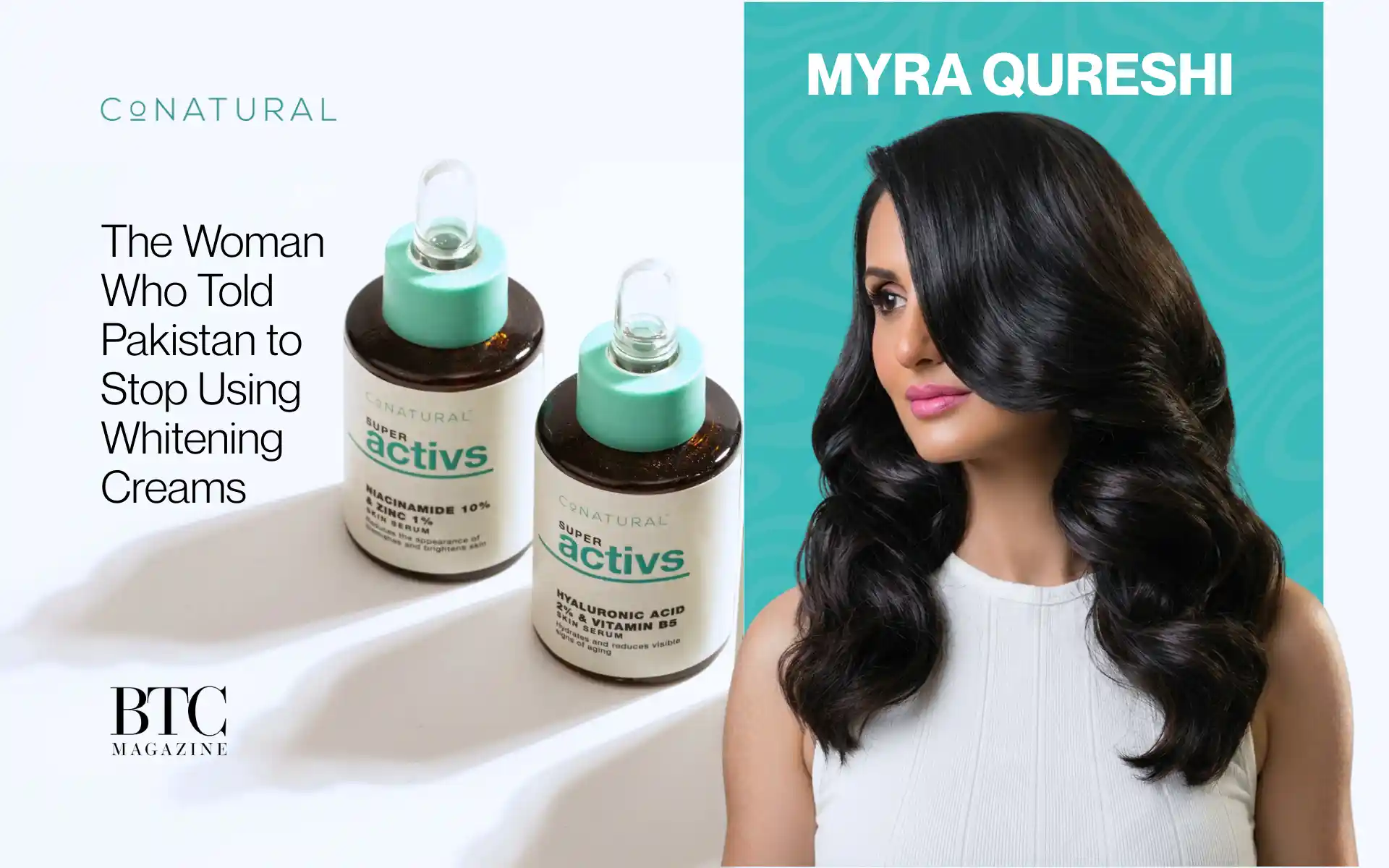
Myra Qureshi looked at that industry and decided to build something better.
Myra didn’t need to come back to Pakistan.
She had the résumé that opens doors anywhere: an LSE degree, an Executive MBA from Georgetown, ESADE, years at Deloitte, Citi, and ING Bank. Thirteen years abroad. Over a hundred countries visited.
But when she returned to Lahore in 2013, she found a problem that wouldn’t let her go.
“I saw everyday creams filled with mercury and steroids being sold as ‘miracle’ products,” she says. “Counterfeit cosmetics. Misleading labels. Women putting toxic ingredients on their skin without knowing what was inside. No one was talking about it.”
So she started building.
In 2014, Myra and her sister Rema Taseer launched Conatural with seven products and a radical premise: beauty shouldn’t require poison.
One of Pakistan’s first natural and organic skincare brands. No whitening creams. No toxic chemicals. No lies on the label. Just products formulated with ingredients you could actually pronounce, manufactured in Lahore, and designed for South Asian skin.
The industry said it wouldn’t work.
Consumers wanted whitening.
Retailers wanted whitening.
Myra built anyway.
By 2020, Conatural had grown to more than 50 products, retail partnerships across Pakistan, and exports to the UK and UAE. That year, mid-pandemic, she raised $825,000 in pre-Series A funding, one of the largest early-stage investments ever raised by a female-founded startup in Pakistan.
She was 37.
In 2023, she raised an additional USD $1 million in Series B funding, scaling Conatural’s footprint even further.
Myra doesn’t call it rebellion. She talks about quality. Standards. Teaching women to read labels.
But what she built is insurgent.
In a market where advertising told women lighter skin meant better lives, Conatural ran campaigns against skin bleaching. In an industry where only 3% of startup funding goes to female founders, she built a company with 70% female employment. In a culture where young women are taught to downplay achievements, she stood in investor meetings and asked for money.
“I always find myself saying ‘we’ instead of ‘I,’” she admits. “Using the first person feels arrogant. I’m petrified that if someone knows it’s just me in control, the value will go down.”
She raised the money anyway.
Every Conatural bottle sitting next to a whitening cream is a counter-narrative. Every woman who chooses natural ingredients over bleach is voting with her rupees. Every label that tells the truth makes the lies harder to sell.
Myra proved that Pakistani consumers will choose integrity if you give them the option. She built a business that competes globally, not by copying Western formulas, but by solving a problem they never had to face.
“If we didn’t believe deep in our hearts that these are the most untarnished, unadulterated, accurately labeled, nourishing beauty products,” she says, “we wouldn’t put our names on them.”
Myra Qureshi is changing what beauty means, through market share, not manifestos.
She didn’t argue with the industry.
She outperformed it.
That’s rebellion with receipts.
Members only from here
You've reached the preview. Subscribe for the full article — plus every issue and subscriber perks.
7-day free trial, then from $3.99/mo. Cancel anytime.
Instant access · Cancel anytime
“I started reading for the fashion pieces, but the essays are what kept me coming back.”
Maya R. · Toronto reader
Myra Qureshi is a Pakistani entrepreneur with an LSE degree, Georgetown Executive MBA, and thirteen years of international corporate experience who returned to Lahore in 2013 and founded Conatural with her sister Rema Taseer. Launched in 2014 with seven products, Conatural is one of Pakistan's first natural and organic skincare brands, built explicitly to reject the whitening cream model that dominates the market.
Whitening creams dominate Pakistani beauty shelves, many laced with mercury or steroids and labeled misleadingly or not at all. They sell a toxic fantasy that lighter skin earns better opportunities, relationships, and social standing. Myra found women applying dangerous ingredients without knowing what was inside, and no one in the industry was willing to say publicly that this was a problem.
By 2020, Conatural had grown to more than 50 products with retail partnerships across Pakistan and exports to the UK and UAE. That year, mid-pandemic, Myra raised $825,000 in pre-Series A funding, having built a brand the industry told her Pakistani consumers didn't want because they were too committed to whitening. The market disagreed.
Keep exploring
Read the full story
7-day free trial · From $3.99/mo
Discover every article featured in our latest BTC issues, bringing the month's stories together in one place, so you can easily read and explore everything.
Read Now →Skin has no pronouns, and neither does great skincare. Discover clean beauty made for every skin type, age, and identity. Honest formulas, clear ingredients, and inclusive beauty that actually belongs to you.
Clean beauty for skin, not labels. Face mists, serums, moisturizers, and masks made for you, whoever you are.
Colour makeup and body care that work with your skin, not against it. Inclusive beauty, made honestly.
Beauty gifts and skincare gifts, curated into sets your favourite person will actually use and love.
You deserve stories that actually get you. A BTC magazine subscription unlocks unlimited access to in-depth, unfiltered articles, exclusive podcasts, and member perks you'll genuinely love. Try it free for seven days, then keep enjoying full access from just $3.99 a month. Cancel anytime, no pressure at all. Ready to go deeper?
7-day free trial, then from $3.99/mo. Cancel anytime.
Comments
No comments yet
No comments to show yet. Subscribe to join the conversation.
Log in or subscribe to comment on this article.